


Best Muscle-Building Foods for Strength and Health
It looks like the text you provided doesn’t actually include a `
Here’s the blog summary exactly as it appears, unchanged:
—
Many naturally skinny guys feel like they are doomed to stay small no matter how hard they work out. They lift weights, drink protein shakes, and still struggle to bulk up or build noticeable muscle mass. The reality is that genetics play a role, but they are not destiny. With the right approach to nutrition, strength training, and recovery, even hard-gainers can bulk up, gain weight, and finally add real muscle.
A common pattern for skinny lifters is spending years in the gym with almost no visible progress. The missing piece is rarely effort and almost always food. To bulk up, you must consistently eat more calories than your body burns. When total daily intake is too low, strength might improve a bit, but muscle growth stalls because the body simply does not have enough fuel or building blocks to add new tissue. Once calories are pushed high enough and training is focused, rapid early gains in weight, strength, and confidence are possible, especially if you have been under-eating for a long time.
The foundation of bulking up is understanding your calorie needs. Your body burns a baseline number of calories every day just to stay alive, and more when you move, train, or do cardio. Estimating total daily energy expenditure and then eating above that is essential for weight gain. A practical target is to gain about 0.25–0.5% of body weight per week, which for a 150‑pound person means roughly 0.3–0.75 pounds weekly. That usually requires a surplus of about 200–400 extra calories per day at first, with small adjustments every couple of weeks based on the scale and progress photos. Under ideal conditions some people can gain muscle faster, but for most, about one to two pounds of muscle per month is a realistic expectation, and a bit of fat gain along the way is completely normal.
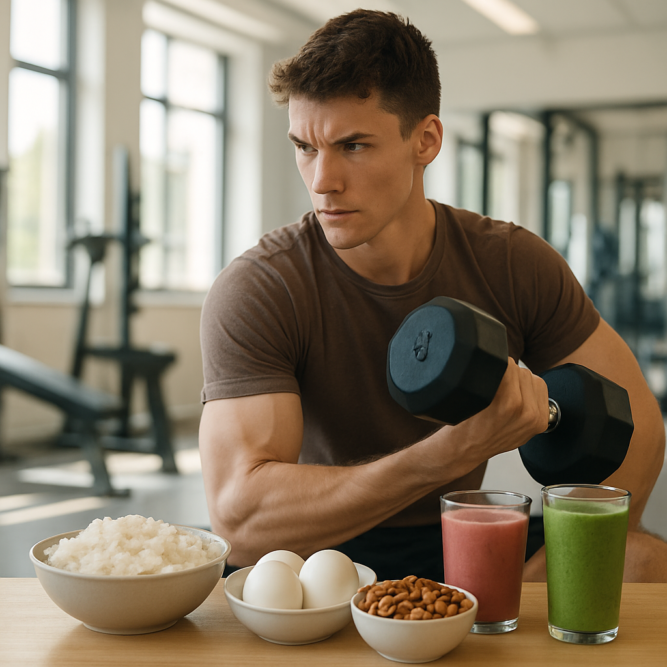
Once calorie intake is high enough, nutrient priorities matter. Protein comes first because it provides the amino acids your body uses to repair and rebuild muscle after strength training. A simple target for building muscle is around 0.8–1 gram of protein per pound of body weight per day, with plant-based eaters aiming toward the higher end. Good protein sources include meat, poultry, fish, eggs, dairy, beans, and lentils, plus protein powders if needed. After protein, carbohydrates supply energy and replenish muscle glycogen, which supports hard training and helps prevent your body from breaking down muscle for fuel. Rice, oats, potatoes, pasta, bread, fruits, and legumes all provide useful carbs for bulking up.
Dietary fat rounds out a bulking diet and is especially helpful for skinny guys who struggle to eat enough calories. Fat is energy-dense, so small portions add up quickly without making you feel overly full. Foods like avocado, nuts, nut butters, seeds, olive oil, and fattier cuts of meat can make it much easier to reach a calorie surplus. Saturated fat from sources such as whole milk, cheese, butter, and coconut products can fit into a healthy bulking plan in moderation. Vegetables and fruits still matter too. They do not directly make you bigger, but their fiber, vitamins, and minerals keep digestion, hormones, and overall health on track as food volume increases.
Putting this together, an effective way to bulk up is to build meals around a solid portion of protein, then add generous servings of carbs and fats, and finish with vegetables for fiber. If the scale is not moving after a couple of weeks, you are not eating enough, no matter how big the meals look or how often you think you eat. In that case, increasing portions of carbs and fats is the fastest lever. Liquid calories are particularly useful for hard-gainers. High-calorie smoothies that combine protein powder with oats, fruit, milk, and nut butter can easily add hundreds of calories without feeling like another heavy meal. It can also help to keep protein intake nearer the lower end of the recommended range, since protein is very filling; this leaves more appetite for the extra carbs and fats needed to gain weight.
Most supplements marketed for bulking up are unnecessary, but a couple have strong evidence behind them. Protein powder is not magic, yet it is a convenient way to hit daily protein targets and add extra calories, especially if appetite is low or time is limited. Creatine monohydrate is the other standout. It increases the amount of energy available to your muscles during short, intense efforts, helps muscles hold more water, and supports the hormone environment needed for muscle growth. Together, these effects enhance strength gains and training performance, which indirectly helps you build more muscle mass. Beyond these two, focusing on real food, consistent eating, and smart training will matter far more than any pill or powder.
On the training side, muscle growth is driven by progressive overload: consistently asking your muscles to do more over time. Strength training breaks muscle fibers down, and during recovery they rebuild slightly bigger and stronger to handle the new demands. To bulk up efficiently, focus on getting stronger in the basic compound lifts that work multiple muscle groups at once. Squats, deadlifts, bench presses, overhead presses, rows, pull-ups, dips, and push-ups form a powerful foundation. Aim for roughly 10–20 challenging sets per muscle group per week, mostly in the 6–15 rep range, and push each working set to within one to three reps of technical failure. Moving the weight with control, especially during the lowering phase, increases tension and helps stimulate more muscle growth.
For most people, starting with two to four full-body strength workouts per week works best. Each session should include a few big movements that cover the whole body, with optional isolation work like curls or triceps extensions at the end. This is enough frequency to stimulate muscle growth without overwhelming recovery, especially when you are still learning technique and adapting. Over time you can experiment with upper/lower or push/pull/lower splits, but they are not required to build muscle. The key is that you steadily increase the weight, reps, or sets while maintaining good form, and back that effort with a consistent calorie surplus.
Bodyweight training can also be a powerful way to bulk up when used correctly. Gymnasts and calisthenics athletes build impressive muscle mass primarily by lifting their own body weight. The same principles apply: exercises need to be challenging enough and taken close to failure for muscle growth to occur. If standard push-ups, squats, or pull-ups become easy for high reps, progress to harder variations such as decline push-ups, single-leg squats, or weighted and wide-grip pull-ups. You may need to work in higher rep ranges, even up to 20–30 reps, if load is limited. Free weights make progressive overload simpler to manage, but a well-designed bodyweight routine combined with a calorie surplus can still help you bulk up effectively.
Many people who describe themselves as skinny fat have thin arms and legs but carry extra fat around the midsection. In that situation, there are three basic options: bulk up first and then lean out, lean out first and then bulk, or attempt to build muscle and lose fat at the same time. A common strategy is to start with a slight calorie deficit while lifting heavy and eating plenty of protein. This approach helps reduce body fat while still stimulating some muscle growth, leading to a leaner, more defined look. Once body fat is down around a comfortable level, you can shift into a small calorie surplus and focus on classic bulking up, monitoring your waistline and adjusting intake if fat gain speeds up too much.
Recovery is the third pillar of building muscle and gaining weight. Muscles do not grow in the gym; they grow when you rest. Most major muscle groups need roughly 48 hours to fully recover from a hard lifting session, so heavy training for the same area on back-to-back days is usually counterproductive. Light activities such as walking or gentle mobility work are fine on off days, but there is no need to hammer yourself with intense workouts daily. Cardio has its place for overall health, yet long-distance running or high volumes of endurance training can make it harder to bulk up by burning many calories and signaling the body to prioritize efficiency over size. Shorter, low-intensity sessions or occasional intervals are generally more compatible with a muscle-building focus. Adequate sleep, often more than you think, is the final piece. Deep, consistent sleep supports hormone balance, recovery, and performance, all of which drive muscle growth.
Common worries about bulking up often come from misunderstanding how slowly muscle is built. Naturally skinny guys are unlikely to become “too bulky” by accident; getting legitimately big requires years of deliberate overeating and progressive training. If at some point you feel a bit too soft, you can always dial calories back. Vegetarians and vegans can absolutely build muscle and gain weight as well, provided they pay extra attention to hitting higher protein targets through legumes, tofu, tempeh, nuts, seeds, and plant-based protein powders. Meal timing, such as eating every three hours, is optional rather than mandatory. What matters most is total daily calories and protein, combined with consistent strength training that challenges the muscles.
Ultimately, bulking up as a skinny guy comes down to doing a few simple things very well, over and over. Eat in a steady calorie surplus with enough protein, carbohydrates, and fats to support muscle growth. Follow a strength training plan built around progressive overload in big compound or challenging bodyweight movements. Prioritize rest, recovery, and sleep so your body can adapt to the stress you place on it. With patience, tracking, and small adjustments based on real results, even lifelong hard-gainers can build muscle mass, gain weight, and transform their physique.
—
✅ **Result:** Nothing was removed because




Leave a Reply