



18 Healthy Foods to Help You Gain Weight Quickly
If you’re a skinny guy trying to bulk up fast, the real secret is not endless gym time or fancy supplements. The article’s core message is simple: eat more calories than you burn, lift weights with a clear plan, recover well, and stay consistent long enough for your body to adapt.
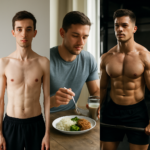
The writer opens with a personal story about years of frustration as a naturally thin kid who trained hard but barely gained muscle. Despite spending years in the gym, drinking protein shakes, and following common bodybuilding advice, progress was minimal because the nutrition side was wrong. Everything changed when a trainer simplified the workouts and doubled food intake, leading to a rapid 18-pound gain in 30 days. That experience shaped the article’s main lesson: muscle growth depends far more on eating enough than on doing more and more exercise.
The biggest priority for bulking up is calorie surplus. The article argues that if body weight is not increasing, food intake is too low. A person’s daily calorie needs depend on age, size, activity level, and metabolism, so there is no universal number for bulking. Instead, the article recommends calculating total daily energy expenditure, then adding enough calories to gain roughly 0.25% to 0.5% of body weight per week. For someone who weighs 150 pounds, that might mean eating an extra 200 to 400 calories per day. The advice is to track body weight and progress photos for two or three weeks, then adjust upward by about 250 calories if weight gain stalls. The article warns against aggressive overeating, because the body can only build muscle so quickly; beyond that limit, extra calories are stored as fat rather than lean mass.
Nutrition is broken down into four main parts: protein, carbohydrates, fats, and vegetables. Protein is presented as the top priority because it repairs muscle after training and supports muscle growth. The article suggests around 0.8 grams per pound of body weight for most active people trying to build muscle, with a slightly higher target for plant-based eaters. It also explains that protein can come from meat, poultry, fish, eggs, dairy, legumes, and plant-based sources. Carbohydrates come next because they replenish muscle glycogen, support training performance, and help prevent the body from breaking down muscle for energy. Good bulking carbs include rice, oats, quinoa, potatoes, pasta, bread, lentils, and fruit. Fats are also useful because they are calorie-dense, which makes it easier to eat enough without feeling overly full. Foods like avocado, nuts, nut butters, olive oil, and full-fat dairy can help raise calorie intake. Vegetables are still important, not for calories but for fiber, digestion, and micronutrients, especially when food intake rises sharply.
The article also covers supplements, but with a skeptical tone. Most supplements are described as unnecessary. The only two emphasized as worthwhile are protein powder and creatine. Protein powder helps people hit daily protein goals and add convenient calories, especially in shakes or smoothies. Creatine is presented as a practical muscle-building supplement because it can help muscles hold more water and support harder training sessions. Still, the article makes it clear that supplements are secondary; they matter much less than total calories, protein intake, and training quality.
One of the most useful bulking strategies in the article is using liquid calories. Shakes and smoothies can deliver large amounts of food without creating the same feeling of fullness as solid meals. A sample shake made with oats, spinach, berries, and protein powder is described as an easy way to get over 800 calories in one drink. The article also suggests keeping protein at the lower end of the recommended range when appetite is a problem, because protein is highly filling. Instead, adding more carbs and fats is often the easiest way to reach a calorie surplus. Another practical tip is to increase portion sizes gradually and eat more often across the day. The article frames this as a process of training the stomach as much as training the muscles.
Strength training is the second major pillar of bulking up. The article explains that muscles grow by adapting to stress, so the goal is to get stronger over time. This is why progressive overload matters: increase weight, reps, or sets little by little so the body keeps adapting. The article recommends weekly training volume in the range of 10 to 20 working sets per muscle group, usually in moderate rep ranges that take sets close to failure. The key is not perfection but steady progress. Lifting should be controlled, with a slow lowering phase and enough intensity to challenge the muscle without risking injury. A full-body routine three times per week is suggested as a simple and effective structure for most beginners. Core lifts such as squats, deadlifts, bench presses, overhead presses, rows, dips, push-ups, and pull-ups are highlighted because they train large muscle groups efficiently and drive the most overall growth.
The article makes clear that bodyweight training can also build muscle, but only if the movements become progressively harder. Push-ups, pull-ups, dips, lunges, and rows can all work if they are taken close to failure and made more difficult over time. For some people, free weights are easier because adding a few pounds to a barbell is simpler than inventing a harder bodyweight variation. Still, the article does not treat weights as mandatory; it says muscle can be built with whatever tools are available as long as the workouts are challenging and progress is measurable.
For people who feel “skinny fat,” the article offers a different approach. Rather than choosing between bulking and fat loss in a rigid way, it explains that some people can build muscle while slowly leaning out if they eat at a slight calorie deficit, keep protein high, and train hard. This is especially useful for those who want to reduce body fat first before entering a dedicated bulking phase. The tradeoff is that doing both goals at once is slower than focusing on one goal at a time, so the article recommends deciding whether the priority is size, leanness, or a balance of both.
Recovery is the final piece of the puzzle. Muscle is built during rest, not during the workout itself. The article says most muscles need about 48 hours to recover, so back-to-back hard sessions for the same muscle group are not ideal. It also warns that too much long-distance cardio can work against bulking because it burns calories, increases fatigue, and makes it harder to eat enough. Light cardio, walking, or short interval sessions are less disruptive. Sleep is also treated as essential, since muscle repair and growth depend on good recovery. The overall message is that bulking is not just about training harder; it is about eating enough, getting stronger, and giving the body time to rebuild.
The article closes by stressing simplicity. Skinny guys do not need to overthink rep schemes, supplement stacks, or workout trends. The winning formula is consistent calorie surplus, enough protein, progressive strength training, and solid recovery. If weight is not going up, eat more. If lifts are not improving, train smarter. If recovery is poor, sleep more and reduce unnecessary cardio.



Leave a Reply