


10 Healthy High-Calorie Recipes for Weight Gain
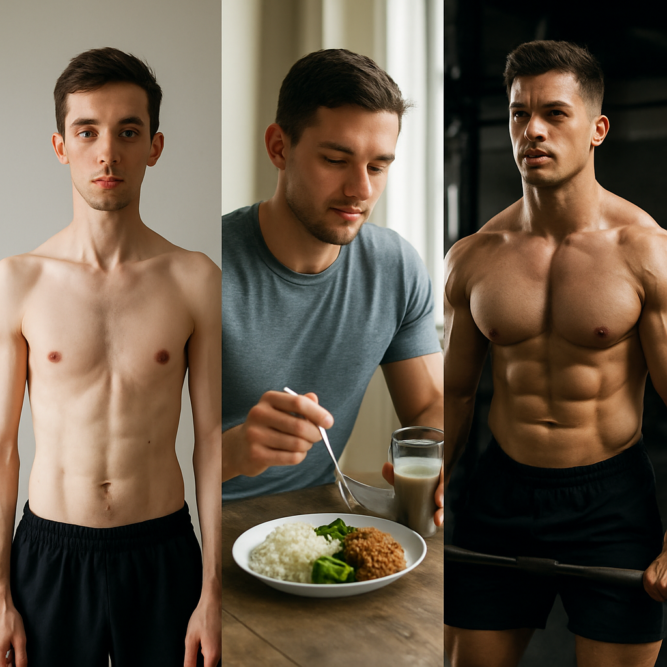
Bulking up fast starts with one simple truth: if the scale is not moving up, the body is not getting enough fuel to build muscle. For skinny guys who struggle to gain weight, the biggest mistake is usually not a lack of effort in the gym but not eating enough calories to support muscle growth. Strength training matters, but muscle is built through a combination of enough food, progressive overload, recovery, and patience. The article’s main message is that gaining size is less about doing endless workouts and more about consistently eating more than the body burns while training in a way that forces adaptation.
The author frames this advice through years of personal trial and error as a naturally skinny person who spent years lifting weights, drinking protein shakes, and still gaining very little muscle. The turning point came after working with a trainer who simplified the workouts and doubled food intake. In just 30 days, weight and strength increased noticeably, which changed the author’s understanding of bulking forever. That experience led to a broader lesson: many people who think they are “hard gainers” are actually just under-eating. The body can burn a large number of calories just through daily life, so a reliable calorie surplus is required if the goal is to bulk like the Hulk.
To estimate how much to eat, the article recommends figuring out total daily energy expenditure, or TDEE, then adding calories based on a realistic weekly weight-gain target. A sensible pace is about 0.25% to 0.5% of body weight per week, which usually means adding roughly 200 to 400 calories per day for a 150-pound person. If weight does not increase after two to three weeks, the solution is to add another 250 calories and reassess. The article warns against trying to gain weight too quickly, since the body has a limited natural rate of muscle growth and excess calories beyond that limit are more likely to become body fat. Slow, steady weight gain is more sustainable and usually leads to better long-term muscle building.
Food quality still matters when bulking, but the article keeps the advice practical. Protein is the top priority because it helps repair and rebuild muscle after training. Good protein sources include meat, fish, eggs, dairy, legumes, and plant-based alternatives. For most active people trying to build muscle, the recommendation is about 0.8 grams of protein per pound of body weight, or about 1 gram per pound for an easier rule of thumb. Plant-based eaters may need slightly more to account for differences in amino acid profiles, but the article makes clear that vegetarian and vegan bulking is absolutely possible with enough planning.
After protein, carbohydrates and fats do most of the work for calorie intake. Carbs refill muscle glycogen, which helps support training performance and prevents the body from breaking down muscle tissue for energy. Foods like rice, oats, potatoes, pasta, quinoa, lentils, and bread are useful bulking staples. Fats are even more calorie-dense, which makes them especially helpful for people who struggle to eat enough. Foods like avocado, nuts, nut butters, and olive oil can add a lot of calories without making meals overly large. Vegetables are still important for fiber, digestion, and micronutrients, especially when eating much more food than usual. The article’s practical takeaway is that if weight is not going up, more carbs and fats should be added to meals.
Supplements are treated as secondary, not essential. Most are described as unnecessary, but two are singled out as genuinely useful for bulking up: protein powder and creatine. Protein powder makes it easier to hit daily protein and calorie targets, especially in liquid form. Creatine helps muscles retain water and can improve workout performance, which supports better training over time. The article also strongly recommends liquid calories, since smoothies and shakes can deliver a lot of nutrition without leaving someone overly full. A large homemade shake with oats, fruit, spinach, and protein powder is presented as an easy way to add substantial calories and protein to the diet.
Training is the second half of the bulking equation, and the article emphasizes that getting bigger requires getting stronger. Progressive overload is the key principle: muscles grow when they are asked to do more over time, whether that means adding weight, increasing reps, or increasing sets. For most people, a good range is 10 to 20 working sets per muscle group per week, with most sets landing in the 6 to 15 rep range and stopping one to three reps before failure. The article also recommends controlled lifting tempo, especially on the lowering phase, and training each major muscle group at least twice per week. Full-body training three days a week is often enough for beginners and is easier to recover from than highly complex routines.
A sample bulk-up workout is included, built around big compound movements such as squats, deadlifts, bench presses, pull-ups, rows, dips, and overhead pressing. These exercises train multiple muscle groups at once and are effective for building both strength and size. The article notes that beginners do not need fancy routines or endless gym sessions. They need a plan, consistency, and gradual increases in load. Rest periods can vary, but the larger point is not to obsess over details. The article repeatedly stresses that the basics matter more than chasing the perfect workout split.
Bodyweight training can also build muscle, as long as it becomes progressively harder. Exercises like push-ups, pull-ups, dips, rows, lunges, and squats can absolutely support bulking, especially when more difficult variations or added resistance are used. Gymnasts are used as an example of how bodyweight training can produce serious muscular development. Still, the article argues that free weights are often easier for beginners because progress is simpler to measure and weight can be added in small increments. The real requirement is not a specific tool but a clear progression path that keeps muscles challenged.
For people who are skinny fat, the article offers a more nuanced recommendation. Rather than jumping straight into a hard bulk, many people in this category may benefit from lifting weights while eating at a slight calorie deficit or at maintenance, especially if body fat is relatively high. This approach can reduce fat while still building muscle, though not as quickly as a dedicated bulk. Once body fat is in a healthier range, calories can be raised to build more size. The tradeoff is simple: doing two goals at once is possible, but neither happens as fast as when one goal gets full focus.
Recovery is the final piece. Muscles grow during rest, not during the workout itself, so sleep and downtime are essential. The article advises avoiding hard training for the same muscle group on back-to-back days and points out that long-distance cardio can interfere with bulking by making it harder to maintain a calorie surplus. Light activity like walking is fine, but too much endurance work can slow size gains. Enough sleep is also non-negotiable, because lifting hard and eating big both demand recovery. For skinny guys trying to bulk up, the formula is straightforward: eat more, train progressively, and recover fully until the body has no choice but to grow.



Leave a Reply