


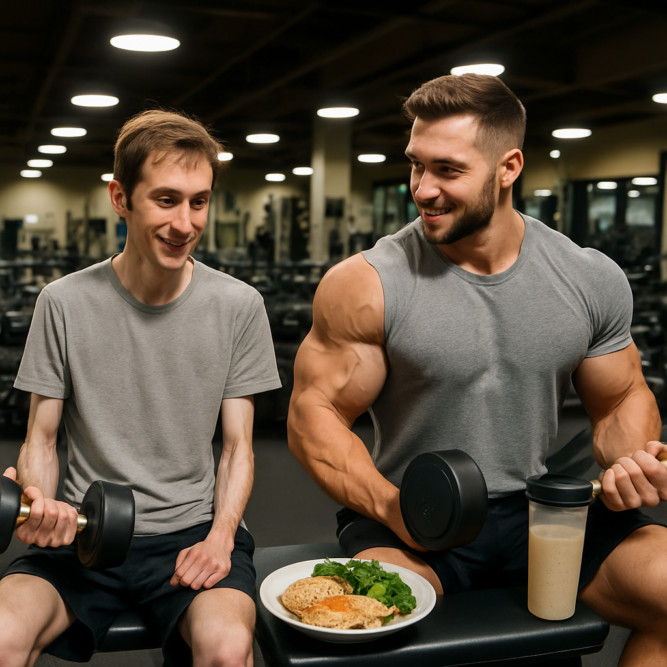
How to Gain Weight Fast: Secrets for Skinny Guys
Many naturally skinny guys spend years in the gym without seeing real muscle growth and come to believe they just can’t gain weight. In reality, even a hardgainer can bulk up fast when three pieces finally line up: eating enough of the right foods, following a smart strength training plan, and taking recovery seriously. The biggest surprise for most people is that bulking up has much more to do with how they eat than with how often they train. Once calories and protein match muscle-building goals and the workout program focuses on progressive overload, the scale and the mirror both start to move in the right direction.
The core mistake most skinny guys make is underestimating how much they eat. The body burns a surprising number of calories just to stay alive, and that daily burn rises further with lifting, walking, and any extra cardio. To bulk up, daily calorie intake has to exceed that total consistently, not just on training days. A simple starting point is to estimate total daily energy expenditure, then aim for a small surplus that produces about 0.25–0.5% of body weight gain per week. For a 150‑pound lifter, that means roughly 0.3–0.75 pounds per week. Tracking food for a few days often reveals intake is far lower than expected. From there, adding 200–400 calories per day and reassessing after two to three weeks works far better than bingeing and hoping for the best. Muscle has a natural speed limit, so gaining very quickly mostly adds fat; steady, modest gains of around half to one and a half pounds per week, or roughly a couple of pounds of muscle a month, are far more realistic and sustainable.
Once calorie targets are clear, macronutrients determine how effectively that surplus turns into muscle. Protein is the top priority because it provides the building blocks for muscle repair and growth. A good rule of thumb is to eat around 0.8 to 1 gram of protein per pound of body weight each day, leaning toward the higher end for vegetarians and vegans who rely on plant-based protein. Meat, poultry, fish, eggs, dairy, legumes, and protein shakes all make it easier to hit this target. After protein, carbohydrates supply fuel for training and refill muscle glycogen so the body does not need to break down muscle for energy. Rice, oats, potatoes, pasta, whole grains, beans, fruit, and other carb sources should appear in generous portions in most meals when bulking. Dietary fat rounds out the calorie goals, supports hormone production, and is very energy-dense, making it useful for hardgainers who get full quickly. Avocado, nuts, seeds, nut butters, olive oil, and full‑fat dairy are all helpful, while saturated fat can remain in the diet in moderation, roughly a small portion of total fat intake. Plenty of vegetables and some fruit add fiber and micronutrients to keep digestion and overall health on track as food volume increases.
For skinny guys who struggle to eat enough, strategy matters as much as food choice. Liquid calories are often the easiest way to increase intake without feeling stuffed. A daily smoothie built from oats, frozen fruit, greens, and protein powder, blended with water or milk, can deliver several hundred calories and a large dose of protein and carbs in just a few minutes. Adding whole milk, coconut milk, nut butters, or a spoonful of olive oil can push those calories even higher. Another useful tactic is to keep protein closer to the lower end of the recommended range if appetite is limited, because protein is very filling; this leaves more room for carb and fat calories that are easier to eat in large amounts. Choosing more flavorful, energy-dense foods and slowly increasing portion sizes over time teaches the stomach to handle more. Eating an extra small meal or snack each day, even when not particularly hungry, is often the difference between maintaining weight and finally gaining.
On the training side, muscle growth hinges on getting stronger through progressive overload. Strength training breaks down muscle fibers; the body then rebuilds them bigger and stronger to handle the next challenge, but only if that challenge keeps increasing. For bulking up, the best return comes from big compound movements that work many muscles at once, such as squats, deadlifts, bench presses, overhead presses, rows, pull-ups, dips, and push-ups. A simple approach for most skinny guys is a full-body workout routine two to four times per week, with each session hitting the major muscle groups. The weekly goal is roughly 10–20 tough sets per muscle group, using weights or variations that bring each working set to within one to three reps of failure.
The most productive rep range for building muscle is usually around 6 to 15 reps per set, where the weight is heavy enough to require effort but light enough to allow good technique and time under tension. Controlled tempo amplifies the stimulus: lowering the weight slowly for two to four seconds, pausing briefly at the bottom, and then driving it back up with intent. Rest periods of about 60 to 90 seconds emphasize muscle growth and endurance, while two to three minutes allow heavier lifting for strength; both approaches can work as long as effort stays high and progress is tracked. Beginners should start with lighter loads, even just an empty bar or bodyweight variations, to dial in technique before gradually adding weight week after week. The key is to “stimulate, not annihilate”: workouts should challenge the muscles without leaving the body so wrecked that recovery becomes impossible.
Bodyweight training alone can also support serious muscle growth when programmed correctly. Gymnasts are proof that lifting one’s own body can create impressive size and strength. The same principle applies: exercises must be hard enough to bring the muscles close to failure. Standard push-ups, bodyweight squats, inverted rows, pull-ups, dips, lunges, and their progressions can all build muscle. When high-rep sets become easy, the difficulty should increase by elevating the feet, changing leverage, working one limb at a time, or adding external resistance. For some lifters, especially at home, experimenting with higher rep ranges up to 20 or 30, combined with advanced variations like decline push-ups or pistol squats, keeps tension high without needing a full gym.
Many naturally thin people fall into the “skinny fat” category, with small arms and legs but a soft midsection, and often wonder whether to bulk or cut first. One effective strategy is recomposition: building muscle while slowly leaning out. This approach uses heavy compound lifting, high protein intake, and a slight calorie deficit to lower body fat percentage while gaining strength and some muscle. A practical goal is to lean down to roughly a moderate body fat range before eating in a surplus to focus on size. The tradeoff is that neither fat loss nor muscle gain happens as rapidly as it would if each were tackled separately, but the process can feel more sustainable, require fewer wardrobe changes, and produce a more athletic look along the way.
Recovery ties the entire bulking strategy together. Muscles actually grow between workouts, not during them, so rest is not a luxury but a requirement. Most muscle groups need around 48 hours to fully recover from intense training, which is why hitting the same body part hard on back-to-back days is rarely ideal. Light activity, walking, or mobility work on off days can support blood flow and overall health without compromising gains. Long-distance cardio, however, can easily interfere with bulking by burning a large number of calories and pushing the body toward endurance adaptation rather than size. For a skinny guy trying to gain weight, it often makes sense to limit extended runs or rides and instead use brief intervals, gentle cycling, or simply a higher step count for cardiovascular benefits.
Adequate sleep is the final lever many overlook when trying to build muscle fast. Deep, consistent sleep supports hormone production, recovery, and performance in the gym. Heavy lifting sessions, especially those involving large movements like deadlifts and squats, dramatically increase the body’s need for rest. Prioritizing seven to nine hours of quality sleep per night can make the difference between spinning wheels and steady strength and size gains. Combined with a calorie surplus built around protein, carbs, and healthy fats, progressive strength training, and thoughtful recovery, this creates a reliable, science-backed path for any skinny guy to bulk up, build muscle, and transform a once-scrawny frame into a stronger, more confident physique.



Leave a Reply