


Bony to Bombshell – Fitness and Nutrition for Women
Bulking up fast as a naturally skinny guy is absolutely possible when the focus shifts from random hard workouts to a simple formula of eating more, lifting progressively heavier, and recovering properly. The key is understanding that muscle is built primarily through consistent strength training supported by a calorie surplus and adequate protein, rather than endless time in the gym or complicated “mass-gainer” tricks.
Many skinny guys believe they “just can’t gain weight” because of genetics, but in most cases the real issue is undereating. The body burns thousands of calories each day simply by existing, and when exercise and daily movement are added, total energy use climbs even higher. If calorie intake does not consistently exceed this total, the body has no surplus energy to dedicate to building new muscle tissue, no matter how many workouts are completed.
A practical starting point is to work out how many calories the body uses daily, often called total daily energy expenditure or TDEE. Once this baseline is known, the goal is to eat more than that amount, aiming to gain roughly 0.25–0.5% of body weight per week. For a 150-pound skinny guy trying to bulk up, that works out to about 0.4–0.75 pounds per week by adding roughly 200–400 calories per day above maintenance and then reassessing progress every two to three weeks.
Tracking intake for a few days using a food diary or app is useful because most people dramatically overestimate how much they eat. If the scale and progress photos show no real weight gain after a couple of weeks, the solution is not more exotic exercises but more food. Adding another 250 calories per day and repeating the process helps find the calorie level that produces steady, manageable weight gain without excessive fat gain.
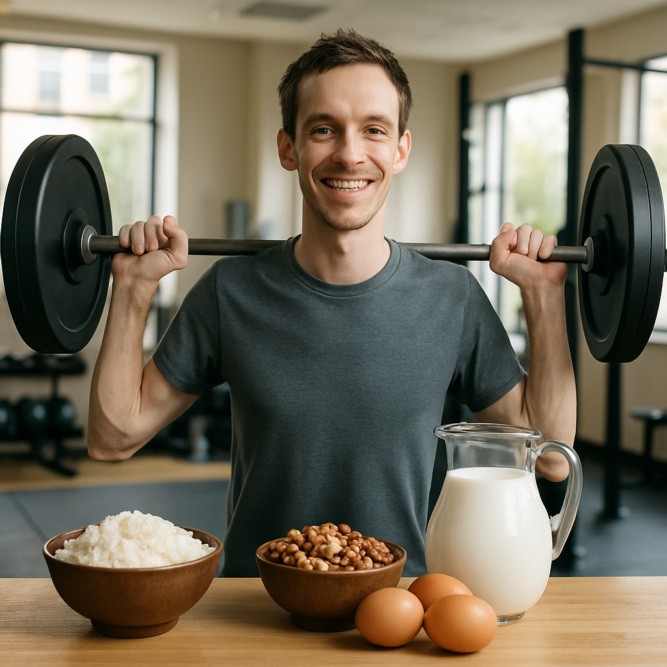
Macronutrients matter, but they are best viewed in order of priority. Protein sits at the top because it provides the building blocks for muscle repair and growth after strength training. A simple rule for a skinny guy who wants to build muscle is to consume around 0.8–1 gram of protein per pound of body weight each day, slightly higher if most protein comes from plant sources. This can come from meat, fish, eggs, dairy, legumes, or protein shakes, which are especially helpful when appetite is low.
Carbohydrates come next because they refill glycogen stores in muscles and support intense training sessions. Rice, oats, potatoes, pasta, bread, beans, lentils, and fruit are all useful, especially in larger portions than a skinny guy might be used to eating. Carbs also make it easier to get into a calorie surplus without feeling overly restricted, and they help prevent the body from breaking down muscle protein for energy.
Dietary fat is the third major piece of the bulking puzzle. Fat is calorie-dense, so a relatively small volume of food can add a lot of energy, which is ideal for someone struggling to eat enough. Foods like avocado, nuts, nut butters, olive oil, and full-fat dairy make it easier to reach higher calorie targets. Even saturated fats from foods like whole milk, fatty cuts of meat, and butter can fit into a bulking diet in moderation as part of an overall balanced approach.
Vegetables and fruit round out the plate by providing fiber and micronutrients, which become more important as total food volume increases. When a skinny guy starts eating significantly more, digestion and “indoor plumbing” benefit from regular servings of high-fiber produce such as broccoli, leafy greens, carrots, and other colorful vegetables. A simple visual guideline is roughly a fist-sized portion of veggies at most meals.
Supplements are often overhyped, but a skinny guy’s guide to bulking up fast can reasonably include two helpful options. First is a basic protein powder, which makes it easier to hit daily protein targets and add calories in the form of shakes. Second is creatine monohydrate, which can increase strength, boost training performance, and add a bit of water weight in the muscles, all of which support mass gain when combined with hard lifting and adequate food.
Liquid calories are particularly useful when appetite is low. Smoothies made with protein powder, oats, milk, nut butter, fruit, and even a bit of oil can pack hundreds of calories into a single glass without feeling heavy. This strategy lets a skinny guy bulk up faster by adding dense nutrition between meals instead of forcing enormous solid-food portions at once, which often leads to discomfort and inconsistency.
On the training side, the fastest path for a skinny guy to build muscle is progressive overload through compound lifts. Every effective bulking plan revolves around getting stronger on big movements like squats, deadlifts, bench presses, overhead presses, rows, pull-ups, and dips. These exercises work multiple muscle groups at once and give the greatest return on effort, especially when performed for 2–3 hard sets of roughly 6–15 repetitions close to technical failure.
Training volume and intensity should be structured but not overcomplicated. Around 10–20 hard sets per muscle group per week is a solid starting point, spread across two to four full-body sessions or an upper/lower split. For most skinny guys, three days per week of full-body strength training hits all major muscles often enough to stimulate growth without overwhelming recovery. What matters most is gradually adding weight, reps, or sets over time while maintaining good form.
Bodyweight training can absolutely help a skinny guy bulk up if the movements are challenging enough. Gymnastic-style exercises like push-ups, dips, pull-ups, inverted rows, lunges, and pistol squats can create plenty of tension in the muscles. The same rule applies: if an exercise can be performed for many easy repetitions, it needs to be made harder by changing leverage, adding weight, or aiming for higher rep ranges to approach failure.
Recovery is the third pillar of bulking up fast. Muscles grow between workouts, not during them, so at least 48 hours of rest for a specific muscle group is usually recommended before heavy training again. Sleep becomes a non-negotiable factor; aiming for around eight hours per night helps hormone levels, training performance, and muscle repair. When heavy lifting is combined with too little sleep, progress stalls quickly, especially for someone already fighting a fast metabolism.
Cardio has its place, but long-distance running or high-volume endurance work can slow weight gain because it burns a large number of calories and encourages efficiency rather than size. For a skinny guy whose main goal is to bulk up, it is usually wise to reduce or pause extensive cardio and, if desired, stick to short low-intensity sessions, occasional sprints, or simply higher daily step counts until muscle-building goals are reached.
Many skinny guys worry about getting “too bulky,” but in practice that rarely happens. Gaining significant muscle mass takes months and years of consistent eating and training. It is much more common to struggle for every pound of muscle than to suddenly become oversized. If fat gain ever feels excessive, adjusting portions and slightly reducing calories quickly brings body composition back in line without losing all the hard-earned muscle.
Skinny-fat individuals, who have thin limbs but carry extra belly fat, can still follow a similar path with a small twist. Combining heavy strength training with a slight calorie deficit and adequate protein allows them to build muscle while slowly reducing body fat. Once body fat drops to a healthier range, calories can be increased modestly to focus more aggressively on size without having to cycle through extreme bulking and cutting phases.
Meal timing does not need to be rigid for effective bulking up. Total daily calories and protein matter far more than whether meals are eaten every three hours. That said, spreading food across several meals and snacks can make it easier for a skinny guy to hit higher calorie goals without feeling overstuffed. Structuring non-negotiable meal slots and consistent eating habits tends to produce better long-term results than sporadic large feasts.
Ultimately, a skinny guy’s guide to bulking up fast comes down to a straightforward blueprint: calculate maintenance calories and eat above that level, hit a solid daily protein target, prioritize compound strength training with progressive overload, limit excessive cardio, and protect sleep and recovery. When these fundamentals are applied consistently and adjusted based on progress photos and scale readings, even the scrawniest frame can gradually transform into a stronger, more muscular physique.



Leave a Reply