


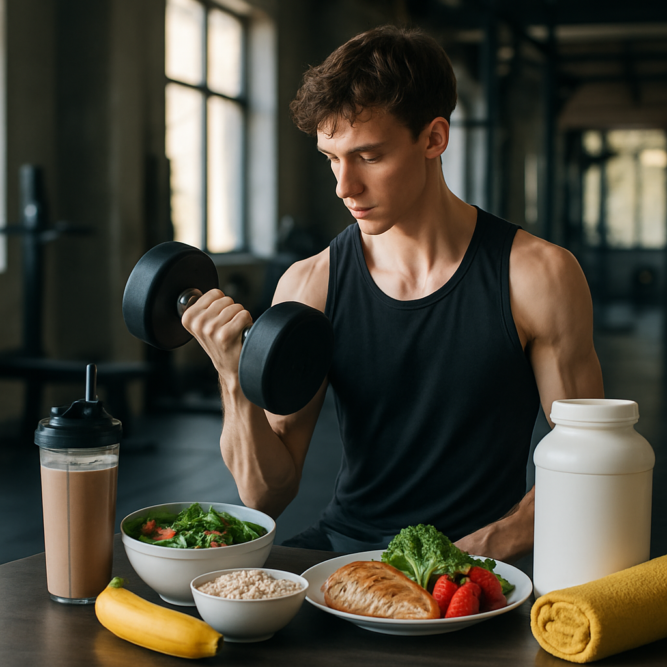
Top 10 Healthful Foods to Gain Weight Fast
Bulking up as a skinny guy is less about doing endless workouts and more about combining enough food, smart strength training, and recovery. The core message of this article is simple: if the scale is not moving up, the body is not getting enough calories to build muscle. For hard gainers, the problem is usually not a lack of effort in the gym, but under-eating, overestimating portion sizes, or relying on cardio and “clean eating” habits that accidentally keep calories too low.
The article opens with a personal story about years of frustration trying to gain size and strength. Early gym efforts produced little muscle because the training was hard but the nutrition was wrong. Everything changed when the approach became simpler: fewer complications in the workout plan and a much bigger intake of food. In a short period, body weight and strength increased noticeably, showing that muscle gain is often driven by consistent calorie surplus, not just more time under the bar.
The main nutrition lesson is that bulking starts in the kitchen. Muscle growth requires energy, and if daily calorie intake does not exceed what the body burns, added muscle will be limited. The article recommends calculating total daily energy expenditure, or TDEE, to estimate how many calories the body uses each day, then eating above that amount. A practical target is to gain about 0.25% to 0.5% of body weight per week, adjusting calories if progress stalls. Tracking food intake for a few days is recommended for beginners because many people think they eat enough when they actually do not.
The article also explains that muscle gain has natural limits. Eating far more than needed will not magically create extra muscle; it usually just adds more fat. A moderate surplus is better than an extreme one because it supports lean mass gain while limiting unnecessary fat gain. Progress should be reviewed every two to three weeks, and calories should be increased if body weight is not rising. In other words, bulk slowly, monitor the results, and make small adjustments instead of chasing dramatic short-term weight jumps.
Protein is presented as the most important macronutrient after total calories. It helps rebuild muscle after training and supports muscle protein synthesis. The recommendation is roughly 0.8 to 1 gram of protein per pound of body weight per day, with a slightly higher intake suggested for plant-based eaters because vegan and vegetarian protein sources can be less complete. Good protein foods include meat, eggs, dairy, fish, legumes, and other plant proteins. Protein shakes can also help, especially for people who struggle to eat enough whole food.
Carbohydrates are the next major priority because they refill muscle glycogen and provide training fuel. When glycogen is low, the body may be more likely to use protein for energy, which works against muscle gain. The article suggests focusing on calorie-dense carbs such as rice, oats, quinoa, potatoes, sweet potatoes, pasta, bread, legumes, and fruit. Fats are also important because they are calorie-dense and make it easier to eat more without feeling overly full. Foods like avocado, nuts, nut butters, olive oil, and full-fat dairy are useful for increasing calories in a practical way.
Vegetables are still part of the bulking plan, mainly for fiber, micronutrients, and digestive health. When food intake goes up, digestion can become a problem, so adding vegetables helps keep things moving and supports overall health. The article uses a simple visual portion guide: protein about palm-sized, carbs about a cupped hand, fats about thumb-sized, and vegetables about fist-sized. This makes it easier for skinny guys to estimate balanced plates without needing to obsess over exact measurements at every meal.
Supplements are treated with skepticism. Most are described as unnecessary, but two are highlighted as genuinely useful for bulking up: protein powder and creatine. Protein powder is a convenient way to raise protein and calorie intake. Creatine helps muscles retain more water and may improve training performance, which can indirectly support muscle growth. Beyond those, the article argues that supplements are not the main issue. If calories, protein, and training are in place, most other products add little.
Liquid calories are strongly recommended for people who have trouble eating enough. Smoothies can deliver a large amount of nutrition without creating the same feeling of fullness as solid meals. The article gives an example shake made with oats, spinach, berries, protein powder, and water, then notes that milk or added fats can make it even more calorie dense. It also advises keeping protein near the lower end of the recommended range if fullness is a problem, because extra protein can crowd out the carbs and fats needed to hit calorie goals. The broader strategy is to increase portion sizes gradually, add meals when needed, and let the stomach adapt over time.
Strength training is the other half of the muscle-building equation. The article emphasizes progressive overload, meaning the muscles must be challenged with gradually heavier weights, more reps, or more sets over time. Bigger muscles come from getting stronger in compound movements such as squats, deadlifts, bench presses, overhead presses, rows, dips, push-ups, and pull-ups. For most beginners, a full-body routine three times per week is recommended because it is efficient and hits each muscle group often enough to stimulate growth.
Training volume, intensity, tempo, and scheduling all matter, but the article keeps the guidance practical. A good starting point is about 10 to 20 working sets per muscle group per week, with most reps falling in the 6 to 15 range. Working sets should usually end only one to three reps shy of failure, and lowering the weight in a controlled way helps both growth and injury prevention. Rest times can vary, but the bigger point is consistency and steady progression. The message is not to overcomplicate the program: pick a routine, lift with purpose, and try to do a little more next time.
Bodyweight training can also build muscle, but it must still follow the same rules of challenge and progression. Exercises like push-ups, pull-ups, dips, lunges, rows, and squats can absolutely lead to size and strength gains if they are hard enough and taken close to failure. The challenge is that bodyweight progressions can be less straightforward than adding plates to a barbell, so some people find free weights easier to track and progress. Either way, the principle is the same: the muscles must be forced to adapt.
For skinny-fat beginners, the article offers a more nuanced approach. Instead of choosing only bulking or only cutting, it suggests that some people can build muscle while losing fat by strength training hard, eating enough protein, and staying in a slight calorie deficit. This works best when body fat is higher and the goal is to improve composition rather than maximize size immediately. Once body fat gets down to a more comfortable level, calories can be increased to focus on gaining size.
Recovery is the final piece. Muscles grow after training, not during it, so sleep and rest matter as much as lifting and eating. Most muscle groups need about 48 hours to recover, so training the same area on back-to-back days is usually unnecessary for beginners. The article also warns that lots of long-distance cardio can make bulking harder because it raises calorie needs and makes it more difficult to stay in a surplus. Light cardio, walking, or short intervals can still fit, but heavy endurance work may slow mass gain. In the end, the formula is straightforward: eat more, lift consistently, sleep enough, and give the body time to rebuild stronger.



Leave a Reply