


Maintaining a Healthy Weight if You’re Underweight
Bulking up as a naturally skinny guy can feel impossible, but the process is far more straightforward than it seems. The real challenge is not a “bad metabolism” or “bad genetics” so much as years of under-eating and unstructured workouts. When a skinny guy finally combines a smart strength training plan with enough calories, protein, and rest, muscle growth and weight gain can happen surprisingly fast. Building muscle is not about living in the gym every day; it is about consistently giving the body a clear reason to grow and the fuel it needs to do it.
The foundation of bulking up is always nutrition. A skinny guy trying to bulk up fast must consistently eat in a calorie surplus, meaning more calories than the body burns each day. Many people think they eat “a lot,” but when intake is tracked honestly for a few days, the numbers usually tell a different story. Using a TDEE (total daily energy expenditure) calculation gives a rough idea of maintenance calories, and then the goal is to eat above that number. A practical target is to gain about 0.25–0.5% of bodyweight per week, which usually means adding a few hundred calories per day and adjusting every couple of weeks based on the scale and progress photos.
Protein is the next critical piece for building muscle. For a skinny guy bulking up, a good rule of thumb is to aim for roughly 0.8–1 gram of protein per pound of bodyweight daily. That amount supports maximum muscle protein synthesis for most people without being unnecessarily high. Protein can come from meat, poultry, fish, eggs, dairy, legumes, or well-planned plant-based sources. Because it is filling, spreading protein across meals and using tools like protein shakes can make it easier to hit daily targets without feeling stuffed all the time.
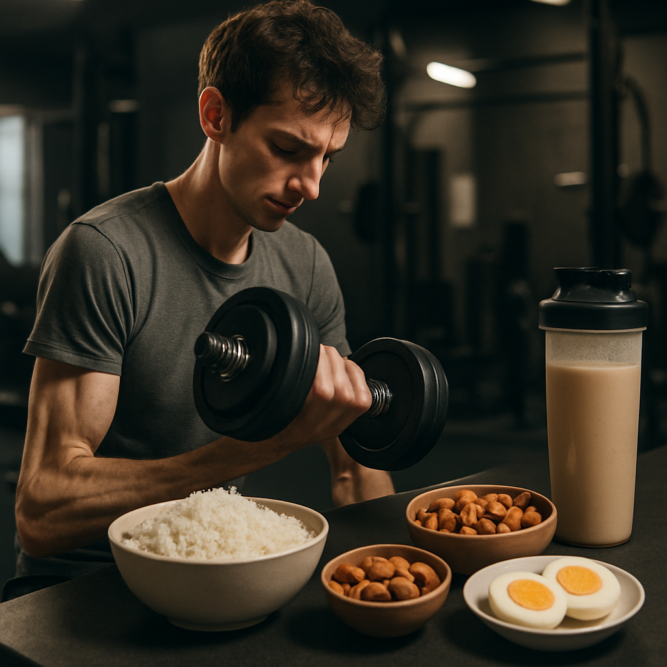
Once protein is in place, the remaining calories should come from a mix of carbohydrates and fats. Carbs are especially helpful when trying to bulk up fast because they refill muscle glycogen and help prevent the body from breaking down muscle for energy. Foods like rice, oats, potatoes, pasta, and whole grains are simple, reliable staples for skinny guys who need more calories. Healthy fats such as nuts, nut butters, avocado, olive oil, and full-fat dairy are very calorie-dense, which makes them ideal for increasing intake without dramatically increasing food volume. Adding an extra spoonful of peanut butter, some olive oil on meals, or a handful of almonds can quietly push daily calories up where they need to be.
Vegetables and fruit still matter even when the goal is bulking up. A higher calorie diet without enough fiber can quickly become uncomfortable. Including a fist-sized serving of vegetables with most meals helps digestion, provides important micronutrients, and supports overall health. Think of each plate as a combination of a solid protein source, a hearty serving of carbs, a thumb-sized portion of fats, and some produce for balance.
Many skinny guys ask what supplements they should take to build muscle. Most products are unnecessary, but two can be genuinely useful. A quality protein powder is a convenient way to boost protein intake and calories, especially in smoothies that also include oats, fruit, and milk or milk alternatives. Creatine monohydrate is another well-researched supplement that supports strength and muscle gain by increasing available energy in muscles and helping them hold more water. Beyond protein powder and creatine, the focus should stay on real food, enough total calories, and consistent strength training.
For those who struggle to eat enough, liquid calories are a powerful tool. A blended shake with protein powder, oats, fruit, spinach, and milk can easily provide hundreds of calories and plenty of nutrients without being as filling as a large solid meal. Slightly lowering protein toward the bottom of the recommended range can also help, since protein is highly satiating. Using more palatable, flavorful foods with a mix of carbs and fats makes it easier to reach a calorie surplus when natural appetite is low. Over time, the stomach adapts, and eating more becomes less uncomfortable.
On the training side, the key to bulking up as a skinny guy is getting stronger through progressive overload. Muscle grows as a response to stress; when you challenge it with heavier weights or harder variations over time, it adapts by getting bigger and stronger. The most efficient exercises are big compound movements such as squats, deadlifts, presses, rows, pull-ups, and dips that work multiple muscle groups at once. A simple approach is to train each major muscle group at least twice per week with about 10–20 hard sets per muscle group per week, using mostly sets of 6–15 reps taken close to muscular failure.
Intensity matters as much as volume. Each working set should finish with only 1–3 reps left in the tank, using a weight that is challenging but still allows good technique. Controlling the lowering phase of lifts for a couple of seconds, pausing briefly at the bottom, and then lifting with intent creates more time under tension and can stimulate better muscle growth while reducing injury risk. Most skinny guys will do very well with two to four full-body workouts per week, rather than complicated six-day splits. As long as the weight on the bar, the reps, or the difficulty of the exercise steadily increase over time, muscle size will follow.
Bodyweight training can also be a powerful way for skinny guys to build muscle, especially when equipment is limited. Movements like push-ups, pull-ups, inverted rows, dips, lunges, and single-leg squats can be progressed in difficulty to stay challenging. The same rules apply: take sets close to failure, aim for roughly 6–30 hard reps per set, and make exercises harder as they become easy. Elevating feet for push-ups, moving toward pistol squats, or adding load to pull-ups are all ways to keep progressive overload going without a barbell.
Some people are “skinny fat,” with thin limbs and a softer midsection, and wonder whether to bulk or cut first. One effective strategy is body recomposition: lifting heavy, eating a slight calorie deficit, and keeping protein high to build muscle while slowly losing fat. This can bring body fat down to a healthier level before moving into a dedicated bulk. The tradeoff is that progress in either direction is slower than focusing purely on gaining or losing, but it avoids large swings in body size and clothing changes and can be easier to maintain psychologically.
Recovery is the final pillar of successful bulking. Muscles grow during rest, not during the workout itself. Training the same muscle groups hard on back-to-back days makes it harder to recover and can stall progress. Allowing roughly 48 hours before working a muscle group intensely again is a good general rule. Sleep is also non-negotiable; building muscle while chronically sleep-deprived is an uphill battle. Aiming for more and better-quality sleep supports hormone balance, recovery, and performance in the gym.
Traditional long-distance cardio can make it harder for a skinny guy to bulk up fast because it burns a lot of calories and sends the body a different adaptation signal geared toward efficiency rather than size. Light activities like walking, short bike rides, or occasional sprints can be included without seriously interfering with muscle gain, as long as total calories remain high. When the primary goal is to bulk up and build muscle, strength training and nutrition should take priority, with cardio kept moderate.
A skinny guy who wants to bulk up and build muscle does not need an extreme or complicated plan. The formula is clear: eat in a consistent calorie surplus with sufficient protein, focus on heavy compound strength training with progressive overload, use bodyweight or weights as available, and prioritize sleep and rest. By tracking food intake, monitoring weight and photos, and making small adjustments over time, even lifelong “hardgainers” can gain weight, add muscle, and transform a skinny frame into a stronger, more muscular physique.



Leave a Reply